
Why, What & How
The missing cerebral cortex for your organization
Totally according to the plan
Let me start with something we've all seen - and probably laughed at a few times too.
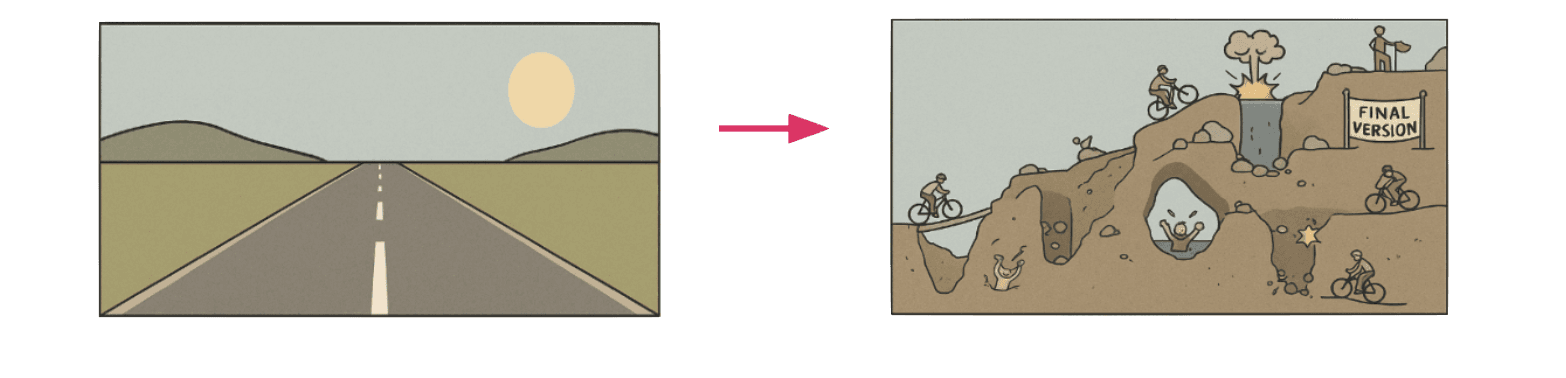
The project plan always looks like this clean, straight highway - clear goals, neat timelines, defined milestones.
But the reality? It looks more like what we see on the right.
It's chaotic. People are falling into holes, riding uphill, rerouting around roadblocks - all just trying to reach that mythical final version.
This isn't just a meme. It's a real reflection of how work actually happens.
The Org structure
So let's break this down - how work flows in every organization.
At the very top, we define strategy and goals. These are the big bets the leadership wants to place for the year - ambitious, clear, and inspiring.
Those goals get broken down into initiatives. These are handled by different business units. Each BU picks up what is relevant to them and starts planning how to deliver on those goals.
And then comes the bottom layer - where the actual work items live. This is where the real day-to-day work happens: tasks, tickets, deliverables, bugs, deadlines - all of it.
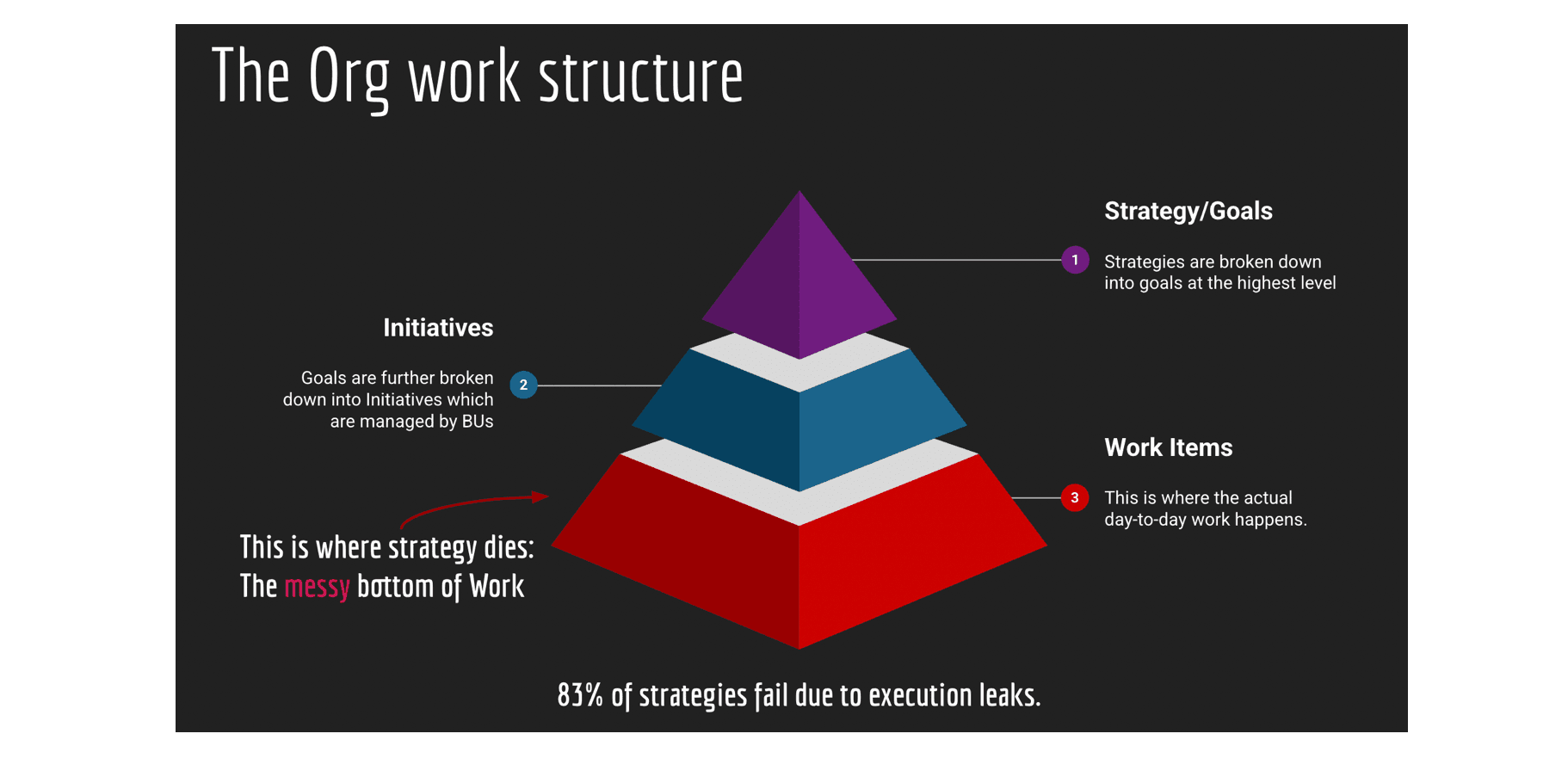
Now if we talk scale - imagine 5 strategic goals can easily explode into 1,500 work items at the execution level. It grows massively and exponentially at the bottom. And here is the truth: this is where strategy dies.
Why? Because the execution layer gets messy. Data isn't updated. Multiple tools create multiple sources of truth. Visibility is lost. The link between strategy and execution - it breaks down.
Chaos. Burnout. Waste
And this mess at the bottom? It leads to chaos, burnout, and waste - and the pain is more acute for Product and Engineering teams.
They work across a jungle of tools - GitHub, Jira, Slack, Figma, Notion, Salesforce, ServiceNow, HR systems, spreadsheets. Each one holds a tiny piece of the puzzle. And that puzzle only makes sense when you bring everything together.
But here is the problem: the more tools you have, the harder it becomes to stitch together a clear picture. Teams end up spending countless hours just trying to connect the dots - mapping updates, syncing statuses, formatting reports - all to build some form of a single source of truth.
And how do we try to solve this? By throwing people at the problem. For every 30–50 engineers or designers, we deploy 1-2 project or program managers - whose sole job is to make some sense of the chaos, to run behind updates, and to prepare for meetings.
We create processes, we set up PMOs, we schedule reviews, stand-ups, retros, status updates - and before we know it, we are stuck in an infinite loop of meetings to prep for meetings, which are prepping for even more meetings.
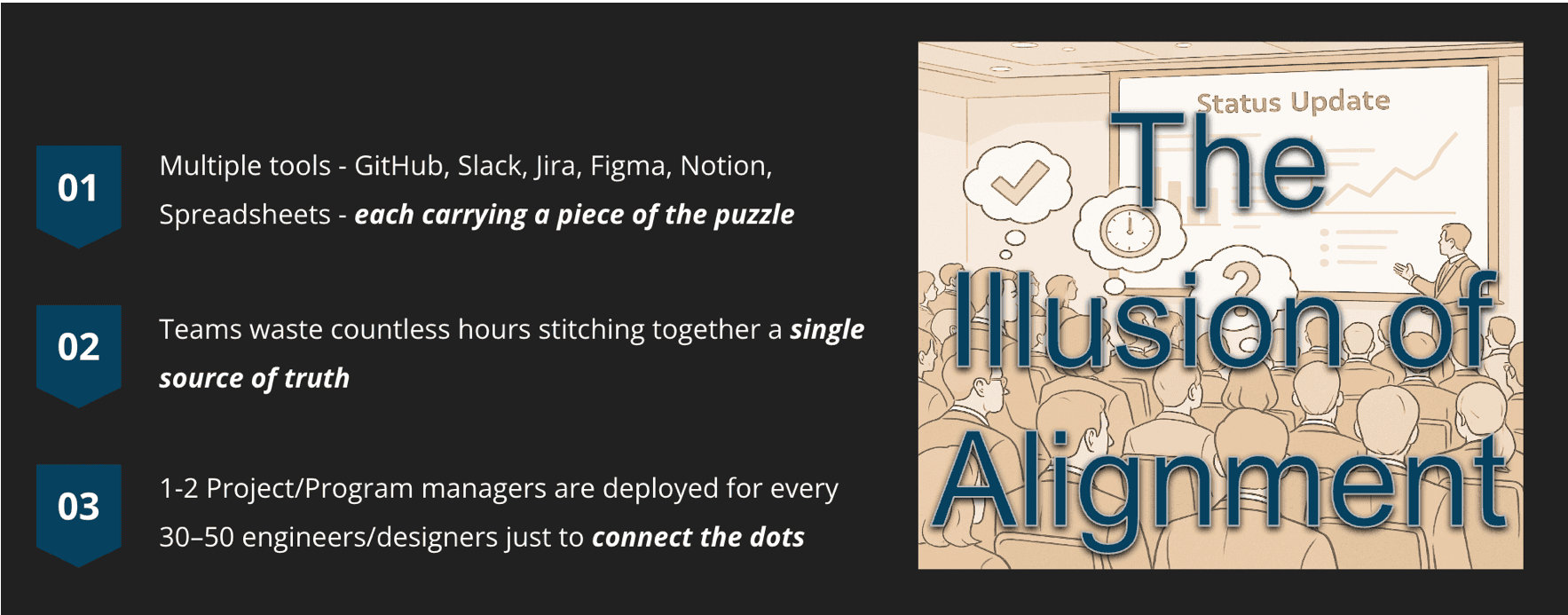
We call this alignment - but in reality, it's just an illusion of alignment.
- We're working on stale data.
- We rely on gut feel over real-time progress.
- And we accept vague phrases like 'almost done', 'we're tracking well', '70% complete' - without any baseline to compare it to.
This illusion is comforting - but it's fragile, misleading, and expensive.
McKinsey's "best-in-class" benchmark
McKinsey's 2024 tech-productivity study found that high-performer IT orgs free up ≈ 30% of their total IT spend through better engineering practices, automation, and tighter cross-functional ways of working
$$$ Waste for a 100 engineer shop (plus 2 human PMs)
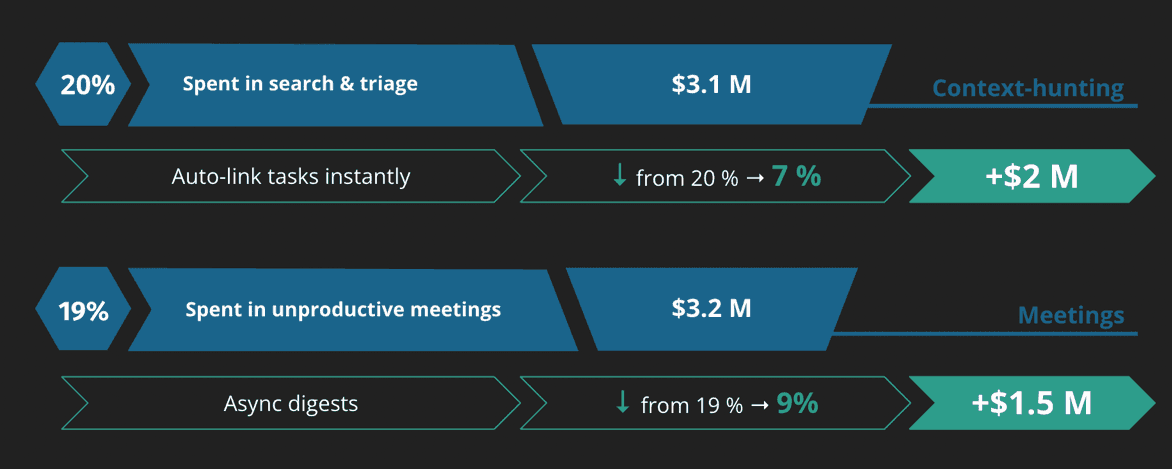
* Conservative payroll: 100 engineers @ $160k fully-loaded + 2 PMs @ $180k → $16.36M / yr.
† Assumes 10 medium projects/yr @ $1M labour each; 45% over-run hits just one project.
Why is this an opportunity?
Let's understand this using a human body analogy.
Think of your organization as a human body.
The Muscles
Jira, ClickUp, Linear, Plane - strong, powerful tools built to execute. They know how to move when told but don't know why.
The Nerves
Glean - brilliant at sensing and delivering information. But not wired to act on that information.
The Reflexes
Zapier, Workato, Relevance AI - automate tasks and respond to inputs. Fast and repeatable, but don't ask why.
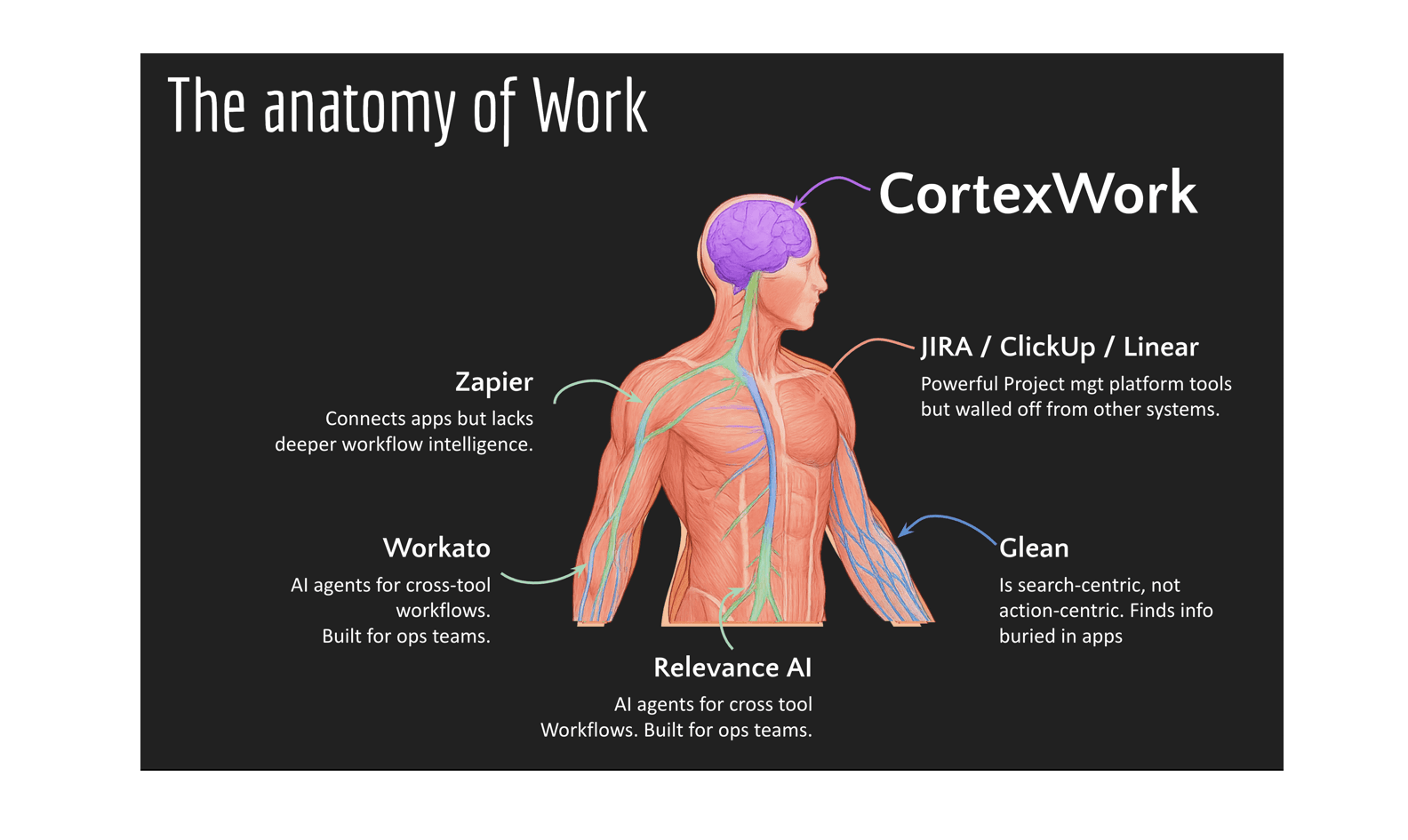
What's Missing: The Cerebral Cortex
In a human body, the cortex gives you consciousness, context, and coordination. It connects what you see, to what you do, to why you're doing it.
In our organizational analogy, this cortex doesn't exist yet.
We have powerful systems doing isolated tasks, but we don't have context stitching - no system that connects a PRD to a developer's code to QA testing to the final deployment and its real-world impact.
We can search, we can automate, we can execute - but we can't connect.
That's the opportunity. To be the cortex.
How?
1. Fix the Foundation
We start with the bottom layer - your work items, your raw data.
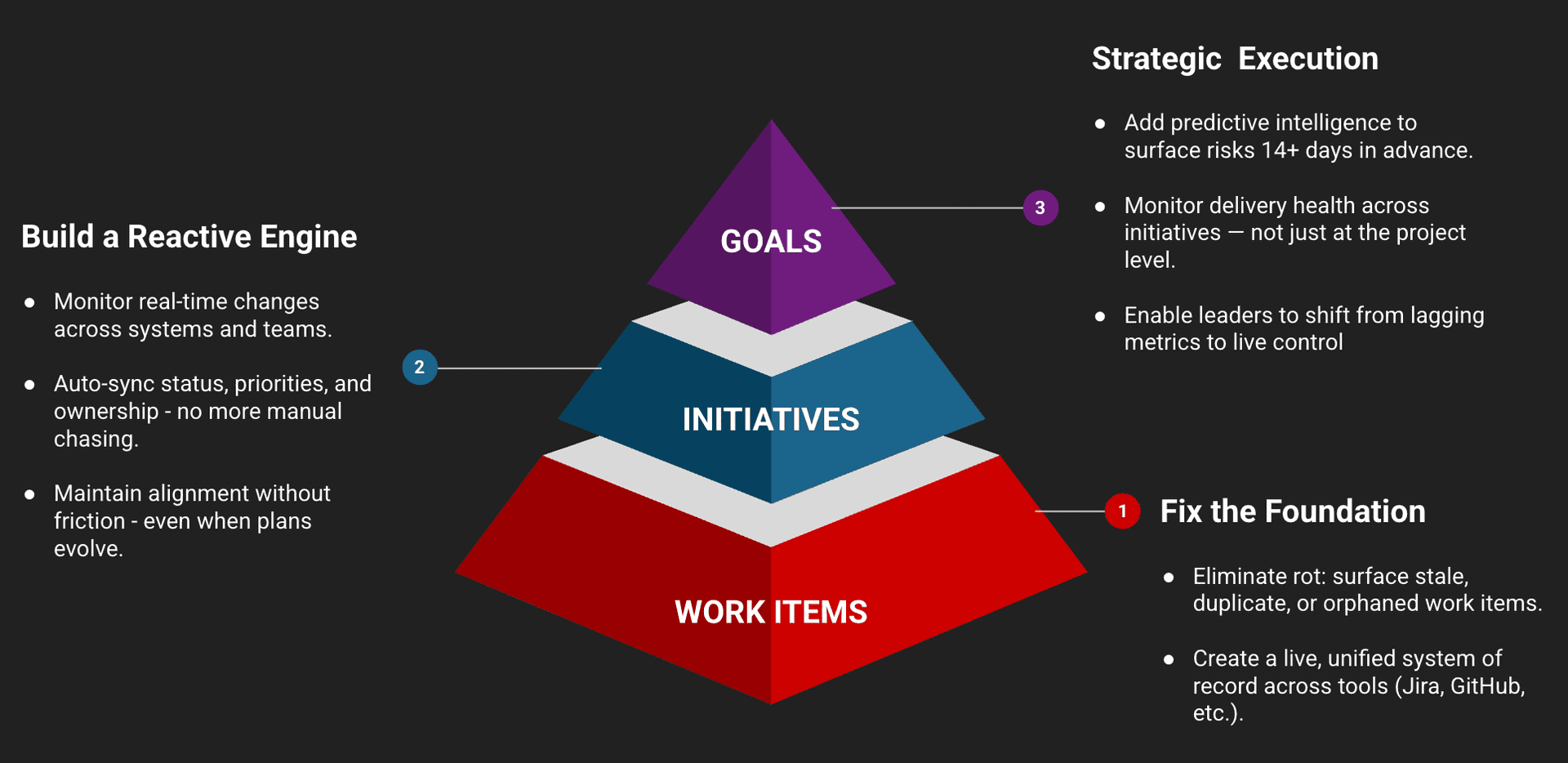
- Right now, this layer is full of garbage: duplicate tickets, outdated issues, disconnected tasks scattered across teams and tools.
- So first, we need to clean it up. Consolidate, deduplicate, and reconnect everything.
- The goal is to create a unified, reliable source of truth - one that the Cortex can actually reason over.
If we don't fix this, any automation or intelligence we build on top will be unreliable.
2. Build a Reactive Engine
With the foundation in place, we move to coordination.
- This is where we build a reactive engine - one that continuously monitors all changes across systems like Jira, GitHub, and more.
- Whenever something changes - an issue moves status, a PR gets merged - the system auto-adjusts everything that depends on it.
- No more waiting for sync meetings or status updates.
This is the nervous system part - where signals flow automatically and the body (your org) responds without delay.
3. Strategic Execution
Now comes the most powerful layer - strategic execution.
- Once everything is clean and reactive, we layer in planning, monitoring, and early warning systems.
- You can track goals, anticipate risks, and intervene before things go off-track.
- This is where the Cortex becomes truly intelligent - moving from just sensing and reacting, to guiding and optimizing.
You're no longer stuck in reactive firefighting mode. You're delivering proactively and strategically.
Conclusion
CortexWork solves the fundamental problem plaguing modern organizations — the disconnect between strategy and execution caused by fragmented tools and systems. While teams juggle dozens of disconnected platforms like Jira, GitHub, Slack, and Figma, spending 30% of their time on manual coordination and working with 48-hour-old data, CortexWork acts as the missing organizational brain that connects everything without disrupting anything. Our three-layer solution transforms chaos into clarity: Foundation (cleaning up fragmented data across all systems), Coordination (providing real-time reactive intelligence that auto-adjusts dependencies), and Strategy (enabling predictive execution with 180-day forecasting and early warning systems).
Through three AI agents - Scout for cleanup, Sync for coordination, and Sense for strategy, we deliver zero-disruption intelligence that adapts to your culture, learns your patterns, and compounds in value over time. The result is organizations moving from reactive firefighting to proactive strategic execution, making one PM feel like ten while eliminating the meetings-about-meetings cycle that burns out teams and wastes resources. We are not building another dashboard, we are building the missing nervous system that makes sense of all your existing tools.